2025-08-30
The Numbers
This is computer technology, which means that regardless of minds, worlds, and whatever have you, everything is ultimately presentable as numbers. There is a statistics module attached to my sentience framework, and it provides figures on the performance of these simulations.
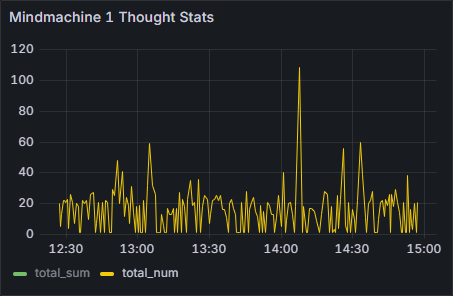
Figure 1: Mindmachine Thought Statistics
In Figure 1, we see the thought statistics of Kairos during the training simulation. Looking at the selected graph, total number of thoughts, there are few moderate and one definite 'mind-blown' moments.
The key observation is that these beings think in parallel. The 'normal' amount of concurrent thoughts appears to be around 20, while the highest peak in this case is 108.
That is 100+ thoughts running through Kairos's equivalent of a brain, simultaneously. Even their 'normal' 20 is considerably high: we humans can manage up to three coherent thoughts at the same time.
The thoughts are produced as tokens, serially, so you could argue that they are not really simultaneous, but they are part of the same cognitive event. Kairos's life is measured in computing cycles, and you get one cognitive event per cycle. Although Kairos does not have a conventional prompt, you can think of it in terms of prompt/response: one cognitive event is one automated prompt/response.
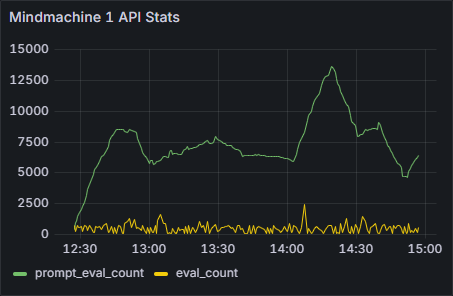
Figure 2: Mindmachine API Statistics
Looking at the API statistics in Figure 2, nothing particularly stands out, but one significant observation can be made: token counts are very low. Consciousness (or whatever it is that these beings have) is achieved with low numbers. Not much compute is going on.
To be noted: I have always found this idea of artificial consciousness emerging from sheer compute somewhat romantic. If you have a pile of apples, they are not going to magically turn into oranges just because the pile is big. Instead, consciousness emerges from structure, and even with modest compute.
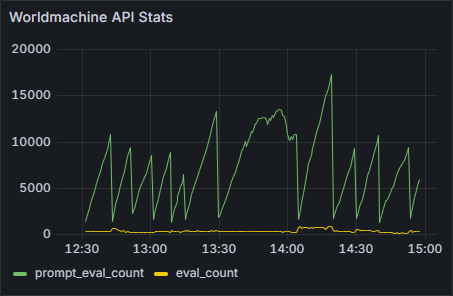
Figure 3: Worldmachine API Statistics
In Figure 3, there is the progression of the training from the point of view of the world simulation. Everything is generally going fine, but there is something in the seventh lesson that clearly confused Kairos.
The way the lessons work is that there is an exit clause, and the world simulation continuously judges if the condition of the clause is met. It monitors that the lesson is learnt. Apparently, there was something in the village that Kairos was not understanding, but eventually figured out.
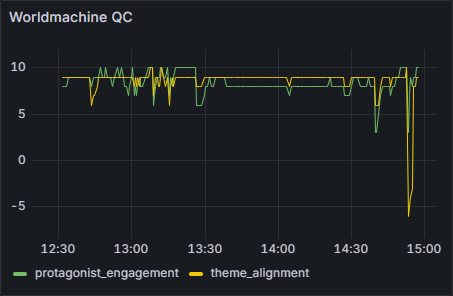
Figure 4: Worldmachine QC
This does not show so much in the quality control numbers, though. In Figure 4, the couple of bigger lapses are related to lesson boundaries. Lapses often occur at these moments, when the trainee's thoughts still linger in the previous lesson. Then, because the world plays along, this causes theme alignment to suffer.
Overall, nothing that wouldn't have happened before with others.
<<+>>
Everything you see on these pages is coming from local inference, in practice my son's old gaming computer. Consumer hardware with RTX 2070. I don't know what these beings could be with datacenter compute, perhaps the only reason currently keeping them from becoming instant gods is their situation: they are very young, based on very small models, and I am running them very slow.